Scotland’s Railways · Callander railway explorer
History
A railway that changed purpose, layout and reach
Origins and construction
Who wanted the railway—and who turned it into a line
The railway did not appear fully formed in 1858. A locally directed company failed in the investment crash of 1846, a second parliamentary campaign revived the route ten years later, and navvies then turned deposited plans into an operating railway across the Teith valley.
The first company
A local railway with £80,000 to find
The first Dunblane, Doune and Callander Railway was authorised on 16 July 1846. Its Dunblane office, local directors and three named engineers show that this was a constituted company, not merely a line sketched on a map. The authorised capital was £80,000 in 3,200 £25 shares, with borrowing powers of £26,666.
What the evidence does—and does not—prove
These names and engineering figures describe the 1846 company and its authorised scheme. They are not automatically assigned to the railway actually constructed after the separate 1856 Act.
Failure and revival
The first attempt ran out of money
Local backing did not overcome the collapse in railway investment after the mid-1840s boom. The first company failed to raise enough capital and the line was not built. By November 1855 a revived provisional committee was again seeking parliamentary powers for a railway from the Scottish Central north of Dunblane, through Doune, to the bleaching green at the east end of Callander.
What the evidence does—and does not—prove
The surviving parliamentary notice establishes the intended route and legal arrangements; it does not prove that every deposited detail was built unchanged.
The company behind the revival
The Scottish Central made the branch viable
The revived company sought powers for the Scottish Central Railway to subscribe capital, hold shares, work and maintain the branch, manage its traffic and divide receipts. The 1856 Act authorised £60,000 of capital; the Scottish Central subscribed £13,400 and later worked the opened railway.
What the evidence does—and does not—prove
The £13,400 subscription is retained as a secondary-source figure. The Gazette notice itself confirms the intended subscription and working relationship but not the final amount paid.
A rival route
Callander might have been reached from Stirling instead
A competing Stirling and Callander Railway was advertised in the same Edinburgh Gazette. Its route would have left the Forth and Clyde Junction Railway near Dasherhead, passed through Gargunnock and Kilmadock, and reached Callander with a branch to Deanston Works. National Records of Scotland identifies Charles Jopp as engineer of the deposited scheme. It was the Dunblane route that received authority and was built.
What the evidence does—and does not—prove
The rival plans survive as an open NRS catalogue record. They show a serious deposited proposal, not a railway that reached construction.
Building the line
Navvies changed Doune before trains did
Construction meant manual excavation, embankments, bridges, track and station works. Doune, near the middle of the route, received an influx of navvies. The surviving local account remembers both the extra trade they brought and the evening disorder that accompanied a temporary labour force.
What the evidence does—and does not—prove
The account establishes the presence and local effect of navvies but does not yet identify contractors, workforce numbers, camps, deaths or individual labourers. Those remain research targets.
What the railway was for
Tourists in summer; coal, lime and goods all year
The new connection cut the cost of coal and agricultural lime, improved the movement of manufactured goods and shortened passenger journeys. The contrast between five trains a day in summer and two in winter reveals how strongly the early service responded to tourist traffic.
What the evidence does—and does not—prove
The five-and-two figures describe the early service pattern cited by the local history and secondary route history. They are not presented as a complete timetable until the underlying timetable is inspected.
Names in the record
The company was made of people
The first prospectus-era company can now be read as an organisation with named directors, advisers and engineers—not an anonymous Victorian enterprise.
The 1846 reference book gives the company office as Dunblane and names Barty as secretary.
The initials are retained exactly as printed. Their responsibility for the later 1856 construction must still be established.
The reference book places local landowners and businessmen visibly behind the first company.
Named by the NRS catalogue for the Stirling and Callander plans deposited in November 1855.
Through time
From an unbuilt first scheme to final closure
The chronology separates the original company, the connected Oban railway, capacity changes and closure in stages.
First authorised scheme is not built
An earlier company obtained authority but failed to raise enough capital.
Revived railway authorised
A new Act authorised the railway from the Scottish Central at Dunblane via Doune to Callander.
Railway opens
The line opened with new passenger stations at Doune and the first Callander terminus.
Company absorbed
The DD&CR was absorbed by the Scottish Central Railway immediately before the wider Caledonian amalgamation.
The Oban route begins from Callander
The connected Callander and Oban Railway opened westwards and introduced the later through station; the first terminus became the goods site.
Drumvaich Crossing opens
The new passing loop divided the single-line section between Doune and Callander.
Dunblane–Doune doubling opens
Doune was rebuilt as an island-platform station and the signalling arrangements changed.
Callander and Oban Junction closes
The approach was remodelled as two single lines, retaining access to the original Callander goods site.
Dunblane–Doune singled
The doubled section returned to single-track operation before final closure.
Passenger railway closes
The route between Dunblane, Doune and Callander closed to passengers and through operation.
Springbank freight remnant closes
The remaining mill siding connection closed; a short permanent-way siding was retained at Dunblane.
Follow the line
The railway from Dunblane to Callander
Begin beside the main line at Dunblane, pass Doune and Drumvaich, and arrive at Callander's two different station stories.
- 01 · junction Dunblane Junction and station 0m 00c
- 02 · goods location Springbank Mill siding Short branch remnant from Dunblane
- 03 · station Doune 3m 38c–3m 50c
- 05 · junction Callander and Oban Junction 10m 15c
- 06 · station Callander (first station) 10m 44c · HES site reference NN 6248 0768
- 07 · connected station Callander (second station) C&O datum 0m 34c · HES site reference NN 62663 08124
The railway through time
Four different railway states
The line did not have one unchanging layout or purpose. These dated states separate the opening route, the through railway, later capacity changes and closure.
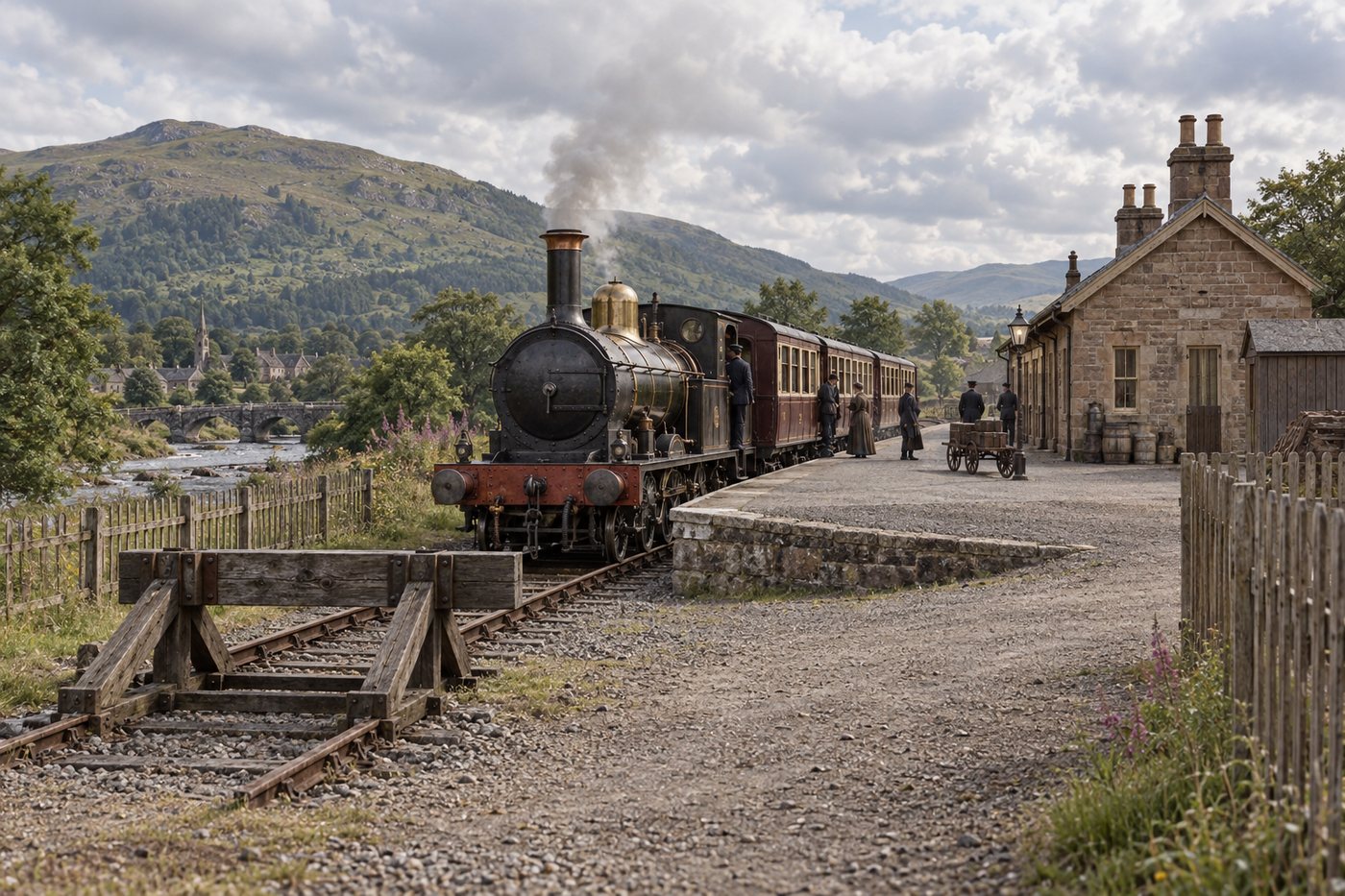
The opening railway
Dunblane, Doune and the first Callander terminus
The new railway opened from the Scottish Central Railway at Dunblane through Doune to Callander. The passenger journey ended at the original station east of the later through station site.
The revived company was authorised in July 1856 and opened the ten-and-a-half-mile railway on 1 July 1858. Dunblane supplied the connection with the Scottish Central Railway; Doune became the principal intermediate passenger station; Callander was reached at a modest terminus on the east side of the town.
At this stage the railway was a self-contained branch rather than the later route to Oban. The first Callander station therefore faced an arriving passenger at the end of the line, with the locomotive needing to prepare for the return journey east.

The route opens west
A through station replaces the terminus
The Callander and Oban Railway carried the passenger route onward from Callander. The later station served through trains, while the 1858 terminus continued as the town's goods-station site.
Opening westward on 1 June 1870 changed Callander from the end of a branch into a through railway town. A new station served the Callander and Oban route while trains from Dunblane could continue towards the Highlands.
The 1858 terminus did not simply vanish: its site continued in goods use. That is why the two station sites tell different parts of the town's railway story and should be viewed together rather than collapsed into a single location.
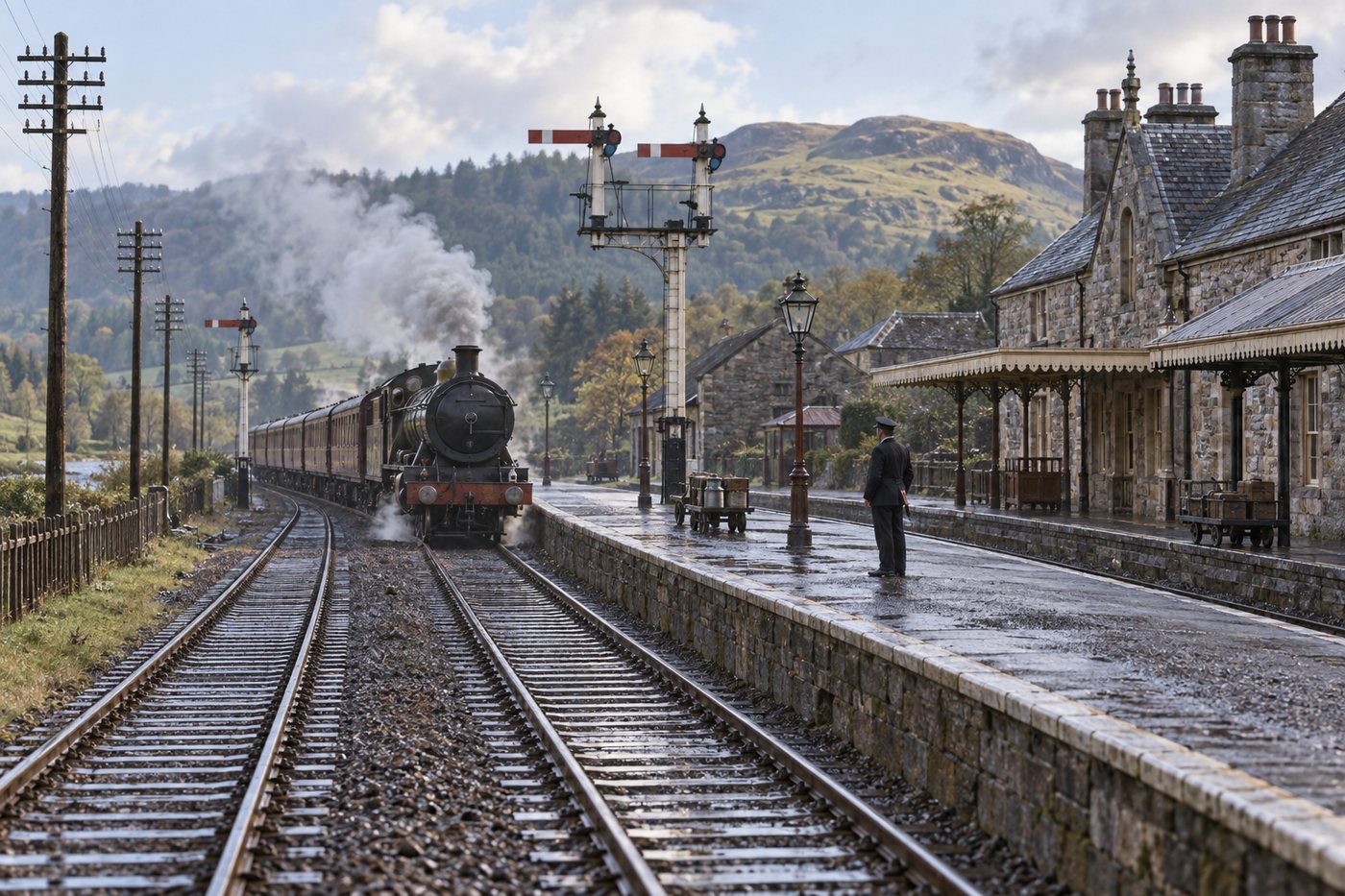
Capacity and crossing
Drumvaich divides the single line; Doune gains double track
Drumvaich Crossing opened in 1893. From 1902 the railway was double track between Dunblane and Doune and single onwards to Callander; the Dunblane–Doune section returned to single track in 1955.
Drumvaich Crossing divided the long single-line stretch between Doune and Callander from 31 August 1893, giving railway staff another controlled place at which opposing trains could pass.
The opening of double track between Dunblane and Doune on 9 June 1902 brought a rebuilt island platform at Doune and altered signalling arrangements. Singling in October 1955 marked the later contraction of the railway before passenger closure.
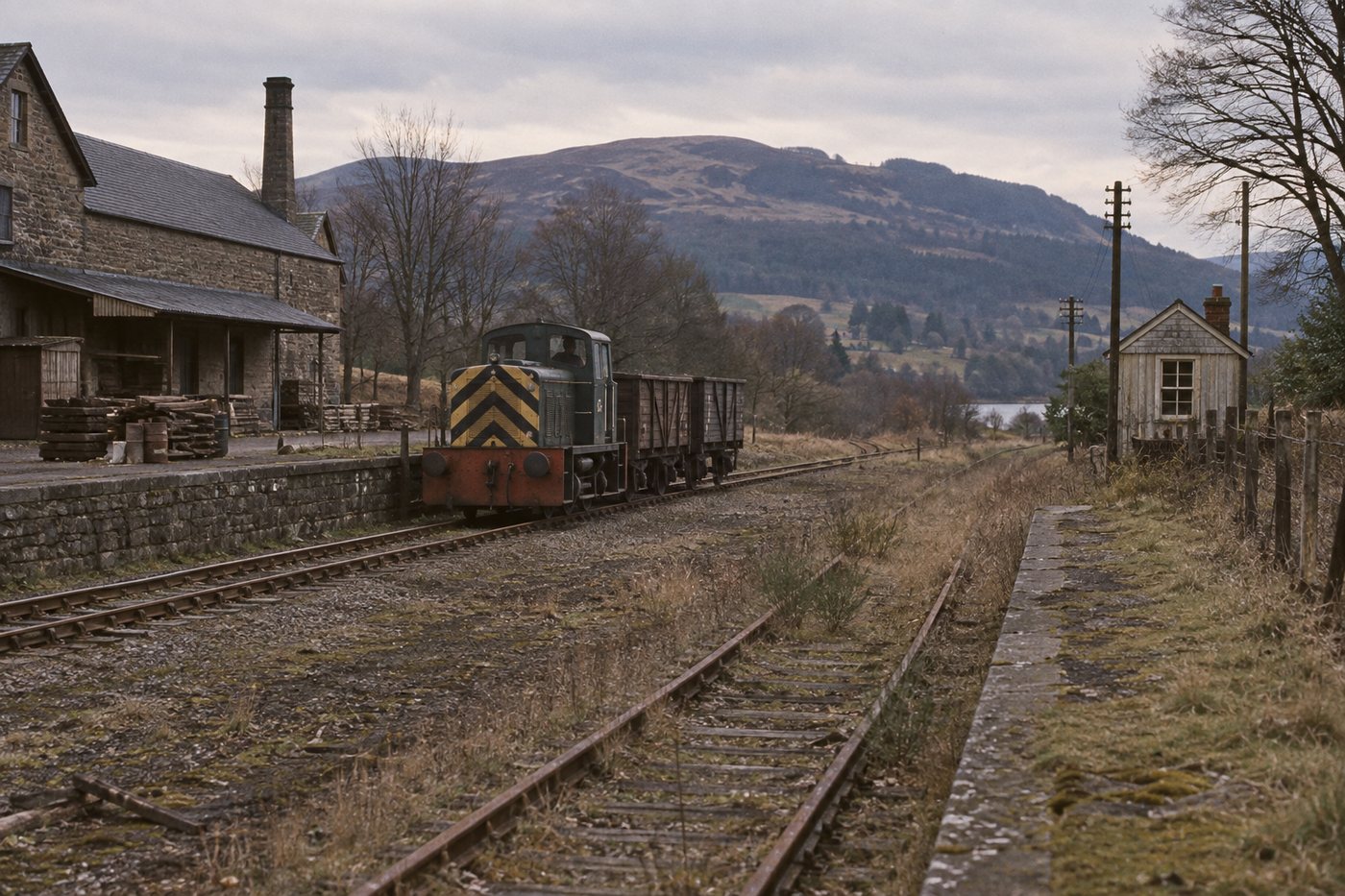
Closure in stages
Passenger closure, then the Springbank freight remnant
Passenger and through operation ended in November 1965. A short freight connection from Dunblane to Springbank Mill survived until 30 July 1971.
Passenger trains and through working ended on 1 November 1965, severing the public railway west of Dunblane. Stations and the wider route closed, but the change was not an instantaneous disappearance of every railway movement.
A short connection from Dunblane to Springbank Mill remained available for freight until 30 July 1971. Its survival explains why the railway's final date depends on whether the story being told is passenger travel, through operation or the last local freight remnant.
Keep exploring this railway
Choose another section
Each subject now has the same permanent place and line menu used by the Waverley Route.