Scotland’s Railways · line explorer
The Waverley Route
Edinburgh Waverley to Carlisle Citadel
Keep exploring the Waverley Route
Choose another section
The complete set of choices stays here on every section page. Your current section is highlighted.
Culture, Posters & Adverts · 1923 · Waverley corridor
The visual world around the railway.
Records must match the selected period. Films must additionally connect to the Waverley corridor—Edinburgh, Midlothian, the Borders or the route itself—so unrelated Glasgow and Highlands material no longer appears here. Broader period posters remain clearly labelled as context.
Set the line in time
Which period are you exploring?
Your choice stays with this railway and governs its dated culture and resources. Every item keeps its own date, place and connection to the line.
Adverts, posters & visual culture · 1923
Inside the chosen period
 1935The Silver Jubilee
 1923Farrah's grocery shop advertisement
 Second World WarWartime glamour and cigarette promotion
 1921Harvey Nichols fashion advertisement
 1924What's Become of the ‘Homely’ Girl?
 1922Holeproof Hosiery illustration
 1927Elizabeth Arden cosmetics
 1941Women of Britain — Come into the Factories
 Second World WarOperation Pied Piper evacuation poster
 c. 1925Order this large Guinness for the home
 1928Spirit of Haig — Great Scot!
 1919Tabu and the modern smoking woman
 1943At War Against the Axis
 1927The Lodger: A Story of the London Fog
 1930Juno and the Paycock
 1930Wellcome Insulin
 1930sKeep Your Hands Soft & White with Zam-Buk
 1935Écosse — Black Watch Pipers
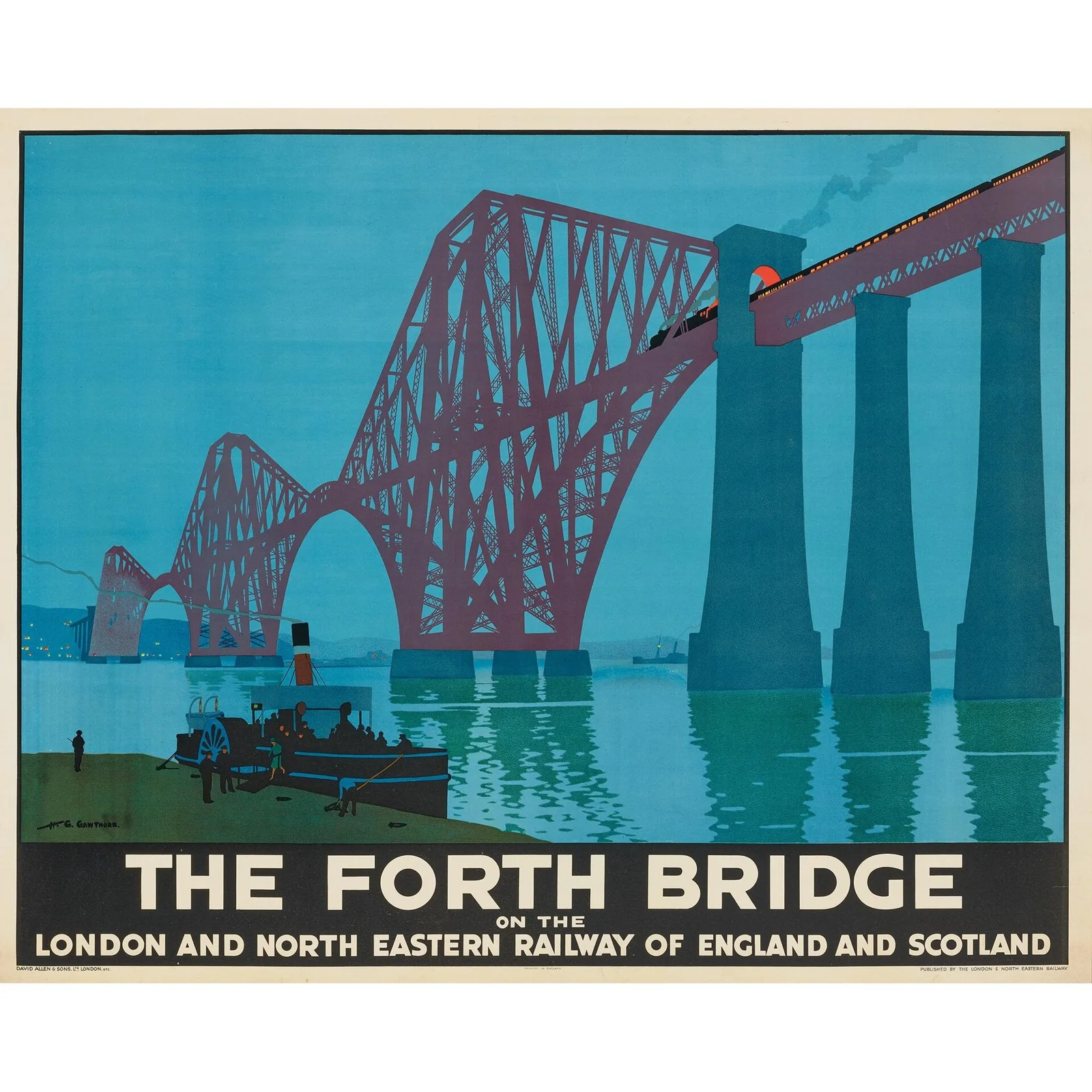 1928The Forth Bridge
 1928Over the Forth to the North
 c. 1930Fraserburgh
 c. 1930St Andrews — Golf
 c. 1926Bridlington
 1925Filey — For the Family
 1939Camping Coaches in England and Scotland
 1929Munich and Central Europe
 1925Harwich–Antwerp
 1928Easy Virtue
 1926The Mountain Eagle
 1929The Manxman
 1928 film; 1929 posterWeekend Wives
 1929Chesterfield Cigarettes
 1930sCape Town to London — Imperial Airways
 1930sSwitzerland by Imperial Airways
 c. 1931RMS Empress of Britain — Canadian Pacific
Railway advertising · 1935
The Silver Jubilee
The Waverley Route was owned and operated by the LNER from 1923 until nationalisation in 1948. This 1935 poster represents the company's wider visual identity; the advertised Silver Jubilee service ran between London and Newcastle and is not evidence of A4 operation over the Waverley Route.
Frank Newbould / London and North Eastern Railway, via Wikimedia Commons · Public domainEveryday advertising · 1923
Farrah's grocery shop advertisement
An English grocery advertisement published in 1923, the year the Waverley Route entered the LNER era. It shows the commercial typography and domestic appeals encountered in contemporary print culture; the older photograph used in the advert appears to pre-date 1914.
Unknown creator, via Wikimedia Commons · Public Domain Mark 1.0Tobacco advertising · Second World War
Wartime glamour and cigarette promotion
A British Ministry of Information photograph of a glamorous promotional image for Turkish cigarettes. It shows how wartime tobacco advertising linked smoking with relaxation, sophistication and femininity; that sales language is part of the historical evidence, not a present-day claim.
Ministry of Information / Imperial War Museums, via Wikimedia Commons · Public domain – UK government workFashion advertising · 1921
Harvey Nichols fashion advertisement
A London department-store fashion advertisement published two years before the Waverley Route entered the LNER era. Its illustration, layout and aspirational sales language show the visual world carried into the early 1920s.
Harvey Nichols advertisement in Illustrated Sporting and Dramatic News, via Wikimedia Commons · Public domain – UK anonymous workSoap advertising · 1924
What's Become of the ‘Homely’ Girl?
A Palmolive soap advertisement by Clarence F. Underwood. It demonstrates how 1920s beauty advertising turned appearance and social approval into sales arguments; those values are historical evidence rather than claims repeated by the Explorer.
Clarence F. Underwood / Palmolive, via Wikimedia Commons · Public Domain Mark 1.0Hosiery advertising · 1922
Holeproof Hosiery illustration
Coles Phillips's illustration of a woman adjusting a stocking was made for Holeproof Hosiery advertising. It records the glamour, styling and increasingly intimate imagery used to sell fashion in the early 1920s.
Coles Phillips / Holeproof Hosiery, via Wikimedia Commons · Public Domain Mark 1.0Cosmetics advertising · 1927
Elizabeth Arden cosmetics
A 1927 cosmetics advertisement photographed by Adolf de Meyer. Its carefully staged elegance shows how luxury brands associated beauty products with celebrity-style portraiture and social refinement.
Adolf de Meyer / Elizabeth Arden, via Wikimedia Commons · Public Domain Mark 1.0Government campaign · 1941
Women of Britain — Come into the Factories
Philip Zec's 1941 recruitment poster asked women to enter wartime factory work. It brings the selected railway period into contact with the labour, gender and national mobilisation experienced across Britain.
Philip Zec / UK Government, Imperial War Museums collection, via Wikimedia Commons · Public domain – UK government workPublic information · Second World War
Operation Pied Piper evacuation poster
A Ministry of Health poster publicising civilian evacuation. Railway stations and trains were central to evacuation, but this particular London Underground poster is included only as national wartime context, not as evidence for a Waverley station.
UK Ministry of Health, via Wikimedia Commons · Public domain – UK government workStout advertising · c. 1925
Order this large Guinness for the home
A Guinness advertisement promoting an economical family-size bottle for home consumption. Its health-inflected language and domestic positioning are characteristic of inter-war alcohol marketing.
Guinness / Wellcome Collection, via Wikimedia Commons · CC BY 4.0Whisky advertising · 1928
Spirit of Haig — Great Scot!
Albert Guillaume's colourful 1928 French poster for Haig whisky uses Scottish identity as its central sales device, showing how a Scottish brand was marketed internationally during the LNER period.
Albert Guillaume / Haig Whisky, Bibliothèque nationale de France, via Wikimedia Commons · CC0 1.0Tobacco advertising · 1919
Tabu and the modern smoking woman
Julius Klinger's poster for Tabu cigarette papers used a confidently smoking woman to suggest modernity and social freedom, recording visual language carried into 1920s tobacco advertising.
Julius Klinger / The Wolfsonian–FIU, via Wikimedia Commons · Public domain