Scotland’s Railways · line explorer
The Waverley Route
Edinburgh Waverley to Carlisle Citadel
Keep exploring the Waverley Route
Choose another section
The complete set of choices stays here on every section page. Your current section is highlighted.
Locomotives & coaches
The locomotives and coaches that worked the Waverley Route
Meet the engines that powered the railway and the coaches in which its passengers travelled. Photographs and explanation are presented here; source and rights records remain available beneath each item.
Locomotives of the route
Power for expresses, local trains and freight

Morayshire at Hawick
No. 62712 Morayshire was transferred to Hawick around 1960, and a surviving John Griffiths photograph records it at Hawick shed. No named Waverley service is yet established.
Explore this locomotive story
SRPS states that Morayshire moved from Thornton Junction to Hawick after two years; the exact transfer date remains unresolved. The original John Griffiths photograph page identifies No. 62712 at Hawick and its reuse permission has been verified, but the image is undated and does not prove a particular train or frequency of use.
- Individual: No. 62712 Morayshire
- Hawick allocation: around 1960–July 1961
- Named Waverley service: not yet established

A rare 9F record
No. 92233 is reported on a down empty-stock working over the route on 20 June 1966; the original periodical record still requires inspection.
Explore this locomotive story
A later transcription, attributed to the RCTS Railway Observer through a 2016 Steam Days article, reports No. 92233 on a down empty-stock train over the Waverley Route and says 9Fs were not common on the line. Preserved No. 92220 Evening Star illustrates the class only and is not the locomotive in that report.
- Reported locomotive: No. 92233
- Reported date: 20 June 1966
- Working: down empty stock · source review pending

The diesel transition
WRHA records Class 17 locomotives D8583 and D8606 working over the route during its final weekend in January 1969.
Explore this locomotive story
WRHA lists D8583 and D8606 among locomotives working over the line on Saturday 4 January 1969. Late on Sunday 5 January, D8606 left Hawick at 23.19 on a proving run ahead of the final southbound sleeper. It was stopped by the protest at Newcastleton and later crossed over at Kershopefoot to return north; it did not haul the sleeper. Preserved D8568 is a modern illustration of the type.
- D8583 and D8606: 4 January 1969
- D8606 proving run: 5–6 January 1969
- Preserved D8568: modern type illustration only

D6851 on the final Saturday
WRHA records D6851 on the late-running 08.30 Carlisle–Millerhill freight at Shankend at 10.55 on 4 January 1969.
Explore this locomotive story
The Bluebell Railway identifies D6851 as a British Rail Class 37, also known as an English Electric Type 3, built in 1963 and later numbered 37151 and 37667. WRHA records the individual locomotive heading north at Shankend with the late-running freight. The displayed 2022 Marks Tey photograph shows the same locomotive in modern operation; it is not the 1969 working.
- Locomotive: D6851 · Class 37
- Working: 08.30 Carlisle–Millerhill freight
- Observed: Shankend · 10.55 · 4 January 1969
Named and special trains
The Waverley, wartime Jellicoe trains, railtours and later special workings connect vehicles with particular railway purposes.
Explore this locomotive story
A named train is a complete working—not a locomotive permanently attached to a name. Timetable, formation, catering, route and traction must be joined only where the evidence supports each relationship.
- The Waverley named express
- Wartime Jellicoe traffic
- Special and railtour workings
Photographed on the railway
Coaches being worked on the Waverley Route
These are complete trains in route context—not detached museum exhibits. They show how the coaches belonged to a working railway, while the captions keep identification within what the photographs and records actually establish.

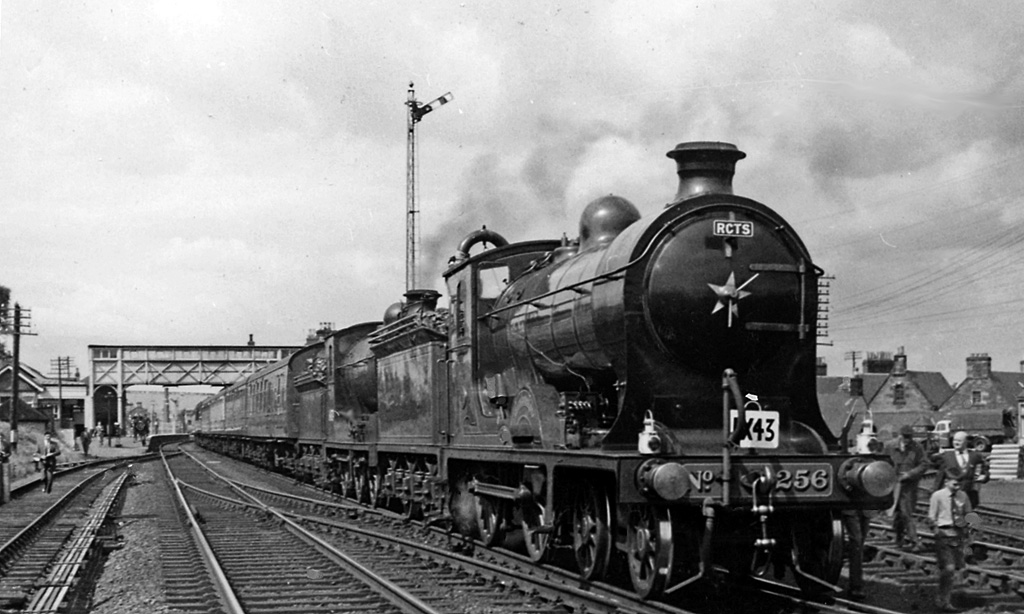
Coaches at St Boswells, 9 July 1961
This is the railway in operation: the RCTS Borders Rail Tour at St Boswells. Its long passenger formation is visible behind D34 No. 256 Glen Douglas and J37 No. 64624.
The photograph proves this special working and its location. It does not by itself identify every coach diagram in the formation.Photograph: Ben Brooksbank · CC BY-SA 2.0 ↗
Waverley Route trains at Carlisle, 1960
At Carlisle, Thompson A2/1 Pacific No. 60507 Highland Chieftain stands with a passenger train while an Ivatt 4MT and another formation occupy the neighbouring line.
Unlike an isolated preserved coach, this view places passenger stock with Waverley Route trains. Individual vehicles still need a carriage-working or diagram source before they are named.Photograph: Ben Brooksbank · CC BY-SA 2.0 ↗Coaches & train formations
The vehicles in which passengers travelled
See the coaches here, then read what each example can—and cannot—tell us about Waverley Route trains. Exact formations are tied to dated evidence; unknown vehicles remain visibly unknown.

Passenger accommodation in Summer 1964
First- and second-class accommodation, compartments, open seating, brake vehicles and catering vehicles will be connected to the services in which they are recorded.
- What BCK meansBrake Composite Corridor: first- and second-class compartments, a side corridor and a guard's brake/luggage section in one vehicle.
- ConstructionThe collection example was built at Derby in 1964 to Diagram 172 and measured 67 feet overall.
- How to recognise itA continuous side corridor serves compartments; fewer passenger windows at one end mark the brake and luggage area.
- Period
- Summer 1964
- What the evidence establishes
- The public timetable establishes services and recorded calls, but does not by itself establish each train's exact coach formation. Formation and vehicle-diagram sources are still required.

The Waverley and its restaurant-car story
A registered publicity timetable identifies The Waverley as a restaurant-car express and provides a starting point for a vehicle-by-vehicle formation study.
- PurposeA buffet or restaurant vehicle supplied food and drink within a through passenger train; it was part of the formation rather than a separate service.
- ConstructionGresley Buffet Car No. 9135 was built at York in 1937 with a teak body and measured 63½ feet overall.
- 1964 timetable clueRC identifies restaurant-car accommodation and TC identifies through-carriage accommodation. Neither abbreviation supplies the complete coach order.
- Period
- Post-1948; exact publicity-card date unresolved
- What the evidence establishes
- The northbound Summer 1964 Table 23 columns directly print RC and TC. The complete vehicle count, types and order have not yet been established.
.jpg)
First, second and third class through time
Earlier periods can explain the changing class system, coach interiors and passenger experience using dated examples relevant to the route.
- Vehicle typeA third brake combined third-class passenger accommodation with a guard's compartment and braking equipment.
- ConstructionEast Coast Joint Stock No. 12 was built at York in 1898 with a varnished teak body; the collection records 56 feet 4 inches over buffers.
- Historical boundaryThird class belongs to the earlier story. The Summer 1964 presentation correctly uses first and second class.
- Period
- Earlier Waverley eras
- What the evidence establishes
- Third-class examples will appear only against an era and source that actually supports them; they will not be applied to the 1964 view.