Scotland’s Railways · line explorer
The Waverley Route
Edinburgh Waverley to Carlisle Citadel
Keep exploring the Waverley Route
Choose another section
The complete set of choices stays here on every section page. Your current section is highlighted.
Waverley Route · sourced line record
Accidents, Disasters & Disruptions
These records describe difficult events in the railway’s history. Official findings, known casualties and gaps in the surviving evidence are kept distinct. Not every operating failure was a disaster, so each record retains its precise category.
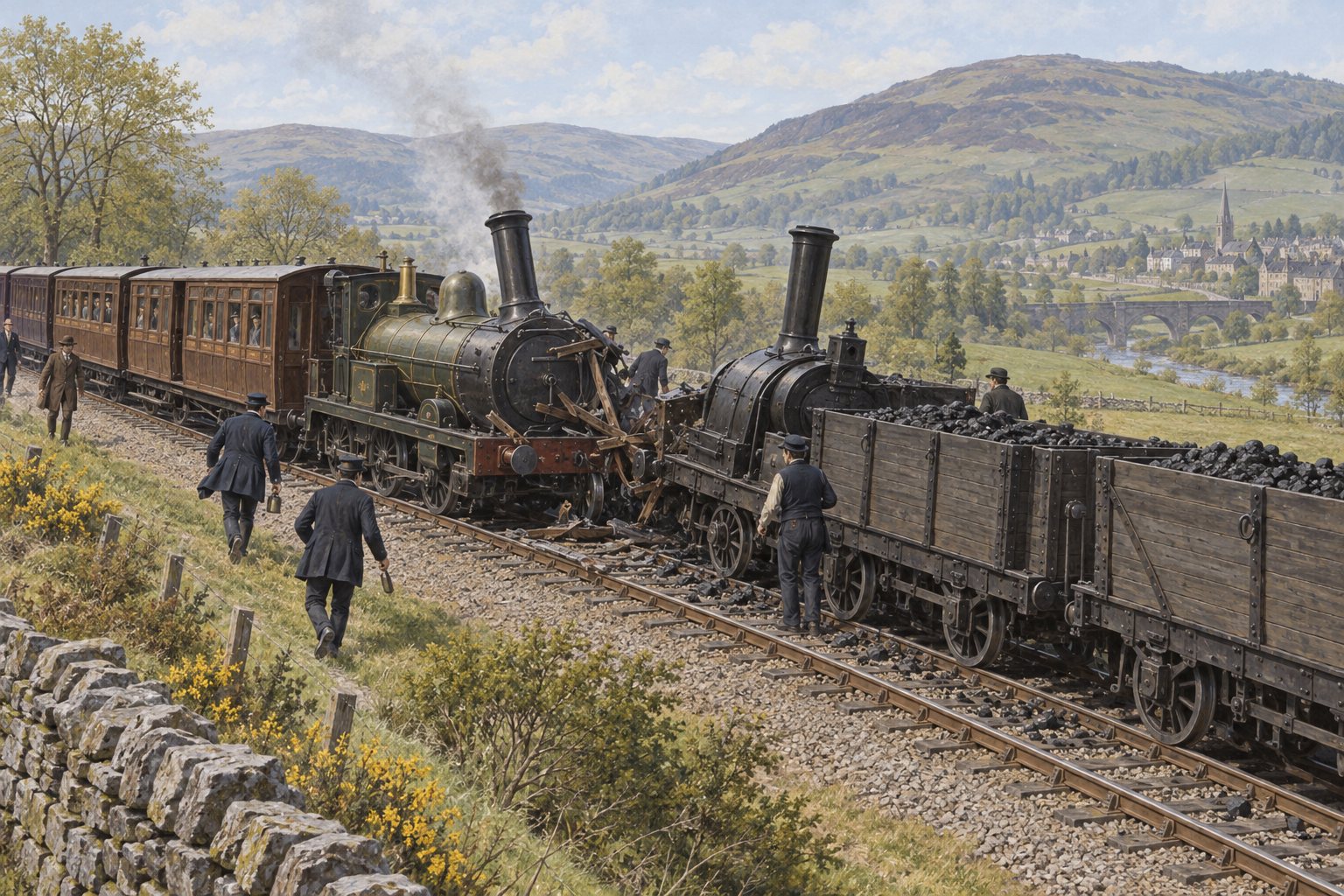
About two miles from Galashiels · collision
Passenger and coal train collision near Galashiels
A North British passenger train collided with a coal train about two miles from Galashiels.
How events unfolded
- A Hawick-bound coal train stopped about two miles beyond Galashiels because tubes in its locomotive were leaking.
- The driver sent his fireman to tell the rear guard to take a warning signal back 600 yards for the following passenger train.
- The guard went back only about 60 yards and waited on the inside of a curve, leaving the stopped coal train inadequately protected.
- The following North British passenger train reached the obstruction and collided with the coal train. No deaths or injuries are recorded in the accident archive.
- Trains or operations
- North British passenger train; coal train
- Fatalities
- 0
- Injuries
- 0
Evidence gap: The exact coordinates, passenger-train timing, collision damage and recovery arrangements remain to be extracted from the complete report.
No authenticated accident-scene photograph or incident-specific film has yet been located.
Read the report record ↗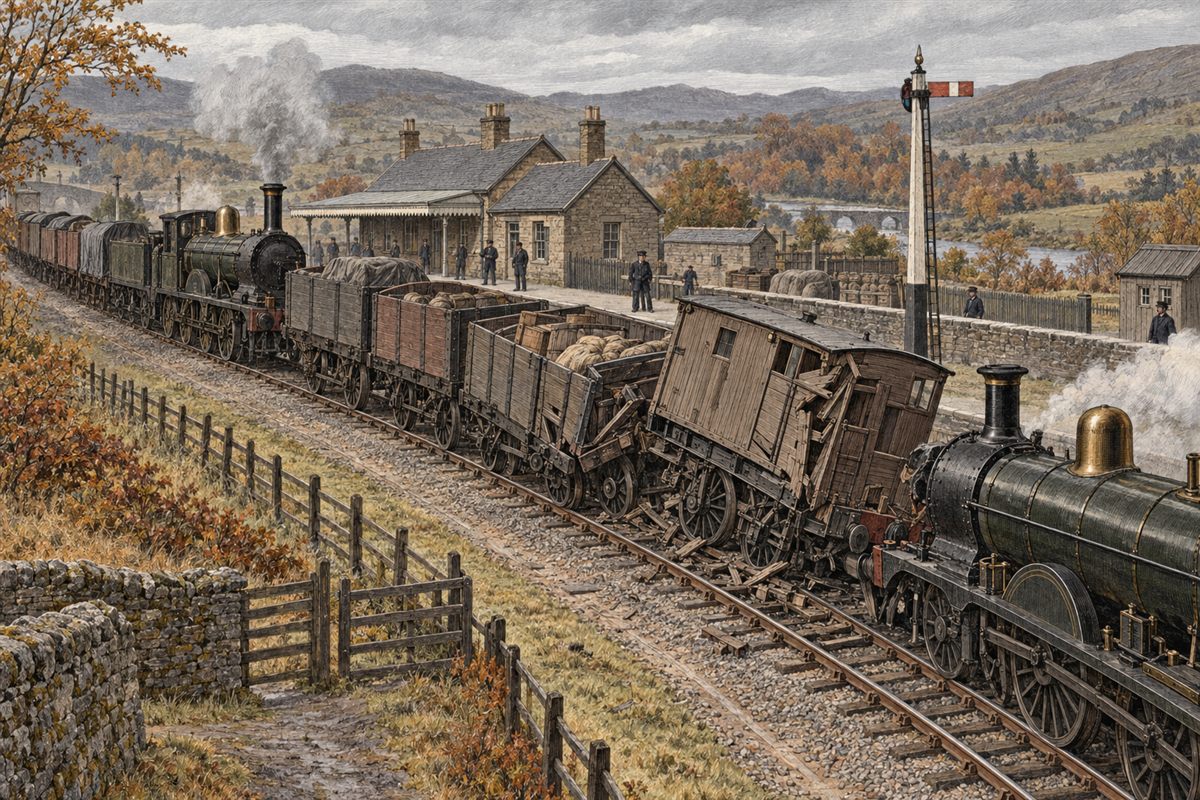
Heriot · collision
Goods train collision at Heriot
A special goods train collided with wagons and the brake van of a regular goods train while the latter was shunting at Heriot.
How events unfolded
- At Newtown, the special goods train was coupled to the regular goods train to assist it up the 1 in 70 bank.
- The trains separated at Fala Hill, with the regular train to continue first and the special to follow.
- While the regular goods train was shunting at Heriot, wagons and its brake van remained on the line ahead of the special.
- The special train struck them and destroyed the brake van, killing one drover and injuring another.
- Trains or operations
- Special goods train; regular goods train
- Fatalities
- 1
- Injuries
- At least 1
Evidence gap: The full report is still required for the exact time, complete signalling sequence, damage, recovery and proof that the recommended signal alteration was completed.
No authenticated accident-scene photograph has been located. The illustration above is an evidence-led interpretation, not historical evidence.
Read the report record ↗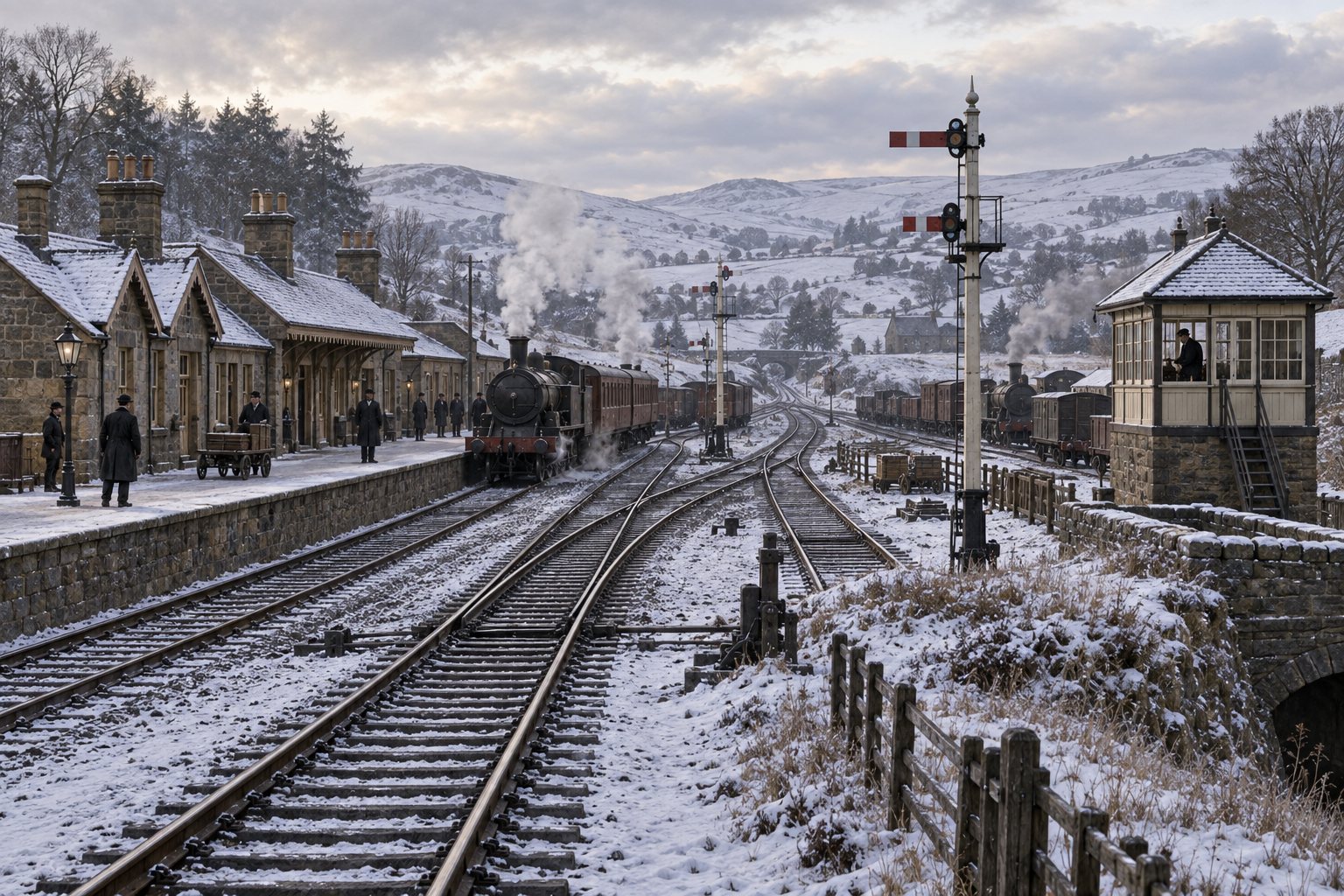
Riccarton Junction · sidelong collision / derailment
Sidelong collision and derailment at Riccarton Junction
The accident archive records a sidelong collision and derailment at Riccarton Junction, causing one injury. The full report sequence has not yet been recovered.
How events unfolded
- An official accident at Riccarton Junction is catalogued for 9 January 1866.
- The catalogue classifies it as a sidelong collision and derailment involving fireman error, the track layout and a secondary driver error.
- One person was injured and nobody was killed.
- The report text has not yet been recovered, so the train movements and detailed sequence cannot safely be reconstructed.
- Fatalities
- 0
- Injuries
- 1
Evidence gap: The trains involved, exact movements, damage, injured person's circumstances and any resulting alteration remain unresolved pending the official report text.
No accident image or public report scan has yet been verified for this occurrence.
Read the report record ↗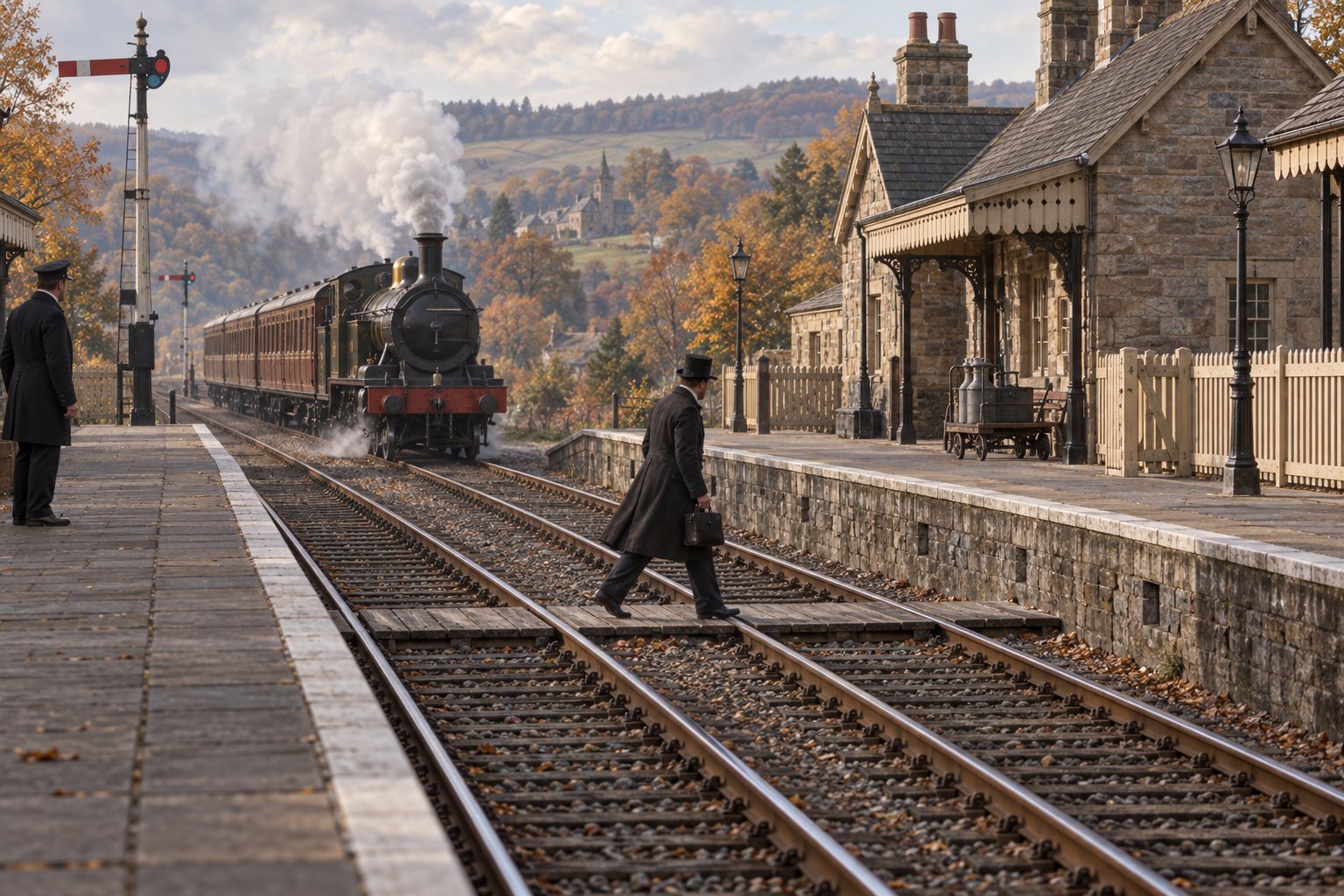
St Boswells · fatal passenger accident
Passenger fatally struck at St Boswells
At about 8:07 p.m., a passenger crossing between platforms was struck as a Berwickshire branch train, running about five minutes late, drew slowly into St Boswells.
How events unfolded
- At about 8:07 p.m., the Berwickshire branch train approached the up platform at a slow pace, around five minutes late.
- A passenger was crossing the railway between the station platforms.
- The locomotive struck the passenger; the crew stopped and went to assist.
- The passenger was freed but died while being carried from the station.
- Trains or operations
- Branch passenger train; passenger on foot
- Fatalities
- 1
- Injuries
- Not established
Evidence gap: The passenger's preceding movements, the authorised crossing arrangements and any subsequent station-working improvement have not yet been established.
No authenticated photograph of the fatal occurrence has yet been located.
Read the report record ↗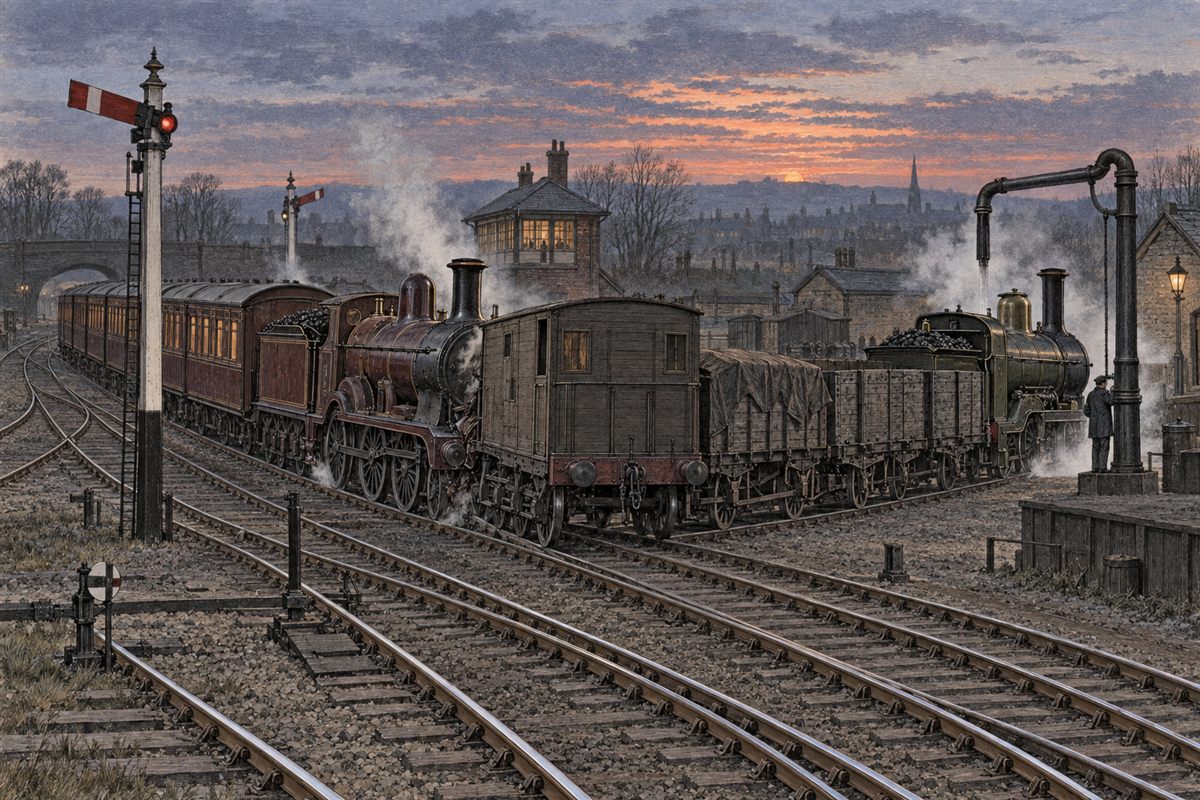
Riccarton Junction · rear collision / derailment
Passenger train struck goods train at Riccarton Junction
An up passenger train approaching Riccarton platform struck the rear of the Portobello goods about 70 yards outside the up home signal while the goods engine was taking water.
How events unfolded
- The 2:30 p.m. up goods from Portobello stood with its rear about 70 yards outside Riccarton's up home signal while its engine took water.
- The 6:20 p.m. Hawick-Carlisle passenger train approached the up platform.
- About 70 yards outside the up home signal, the passenger train struck the rear of the goods train.
- Eight people were injured; the report criticised driver error, signalling, interlocking and track arrangements.
- Trains or operations
- 6:20 p.m. up passenger Hawick–Carlisle; 2:30 p.m. up goods from Portobello
- Fatalities
- 0
- Injuries
- 8
Evidence gap: The report criticises the arrangements, but a completed improvement and its date have not yet been established. Collision time, damage and restoration also remain to be extracted.
No authenticated accident-scene photograph has been located. The illustration above is an evidence-led interpretation, not historical evidence.
Read the report record ↗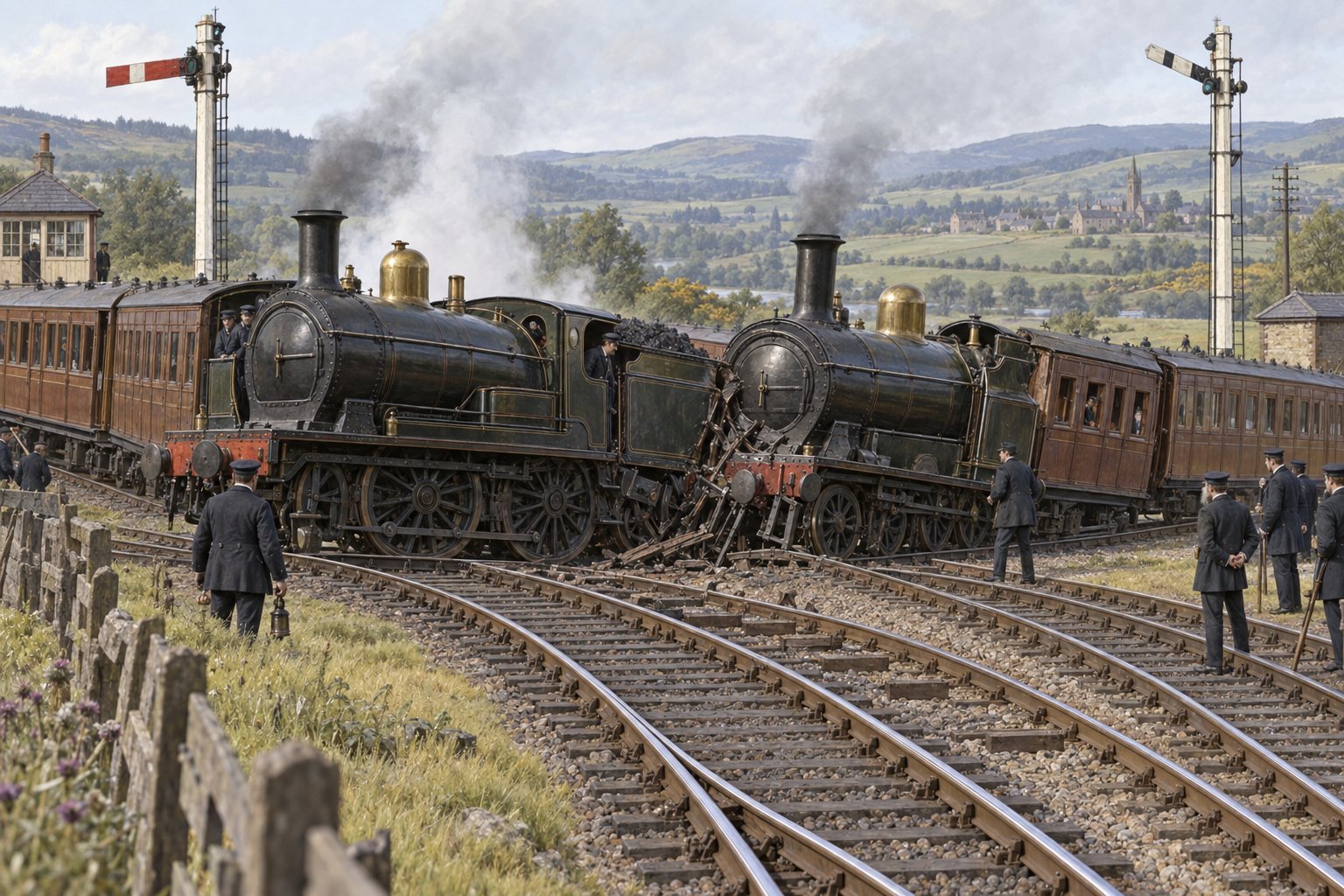
Kelso Junction, near St Boswells · sidelong collision
Passenger train collision at Kelso Junction
A sidelong collision occurred between two passenger trains at Kelso Junction, a short distance south of St Boswells station.
How events unfolded
- A main-line passenger train approached Kelso Junction with its signals cleared.
- A branch passenger train also approached; its distant and home signals were at danger according to five witnesses.
- The branch driver continued into the conflicting movement and the two trains met in a sidelong collision.
- The inspector described the impact as slight but argued that block working should have prevented the trains reaching the junction together.
- Trains or operations
- Two passenger trains
- Fatalities
- Not established
- Injuries
- Not established
Evidence gap: Train identities, casualty totals, damage, reopening time and confirmation of when block working was introduced require the complete report or later records.
No authenticated accident-scene photograph or dedicated film has yet been located.
Read the report record ↗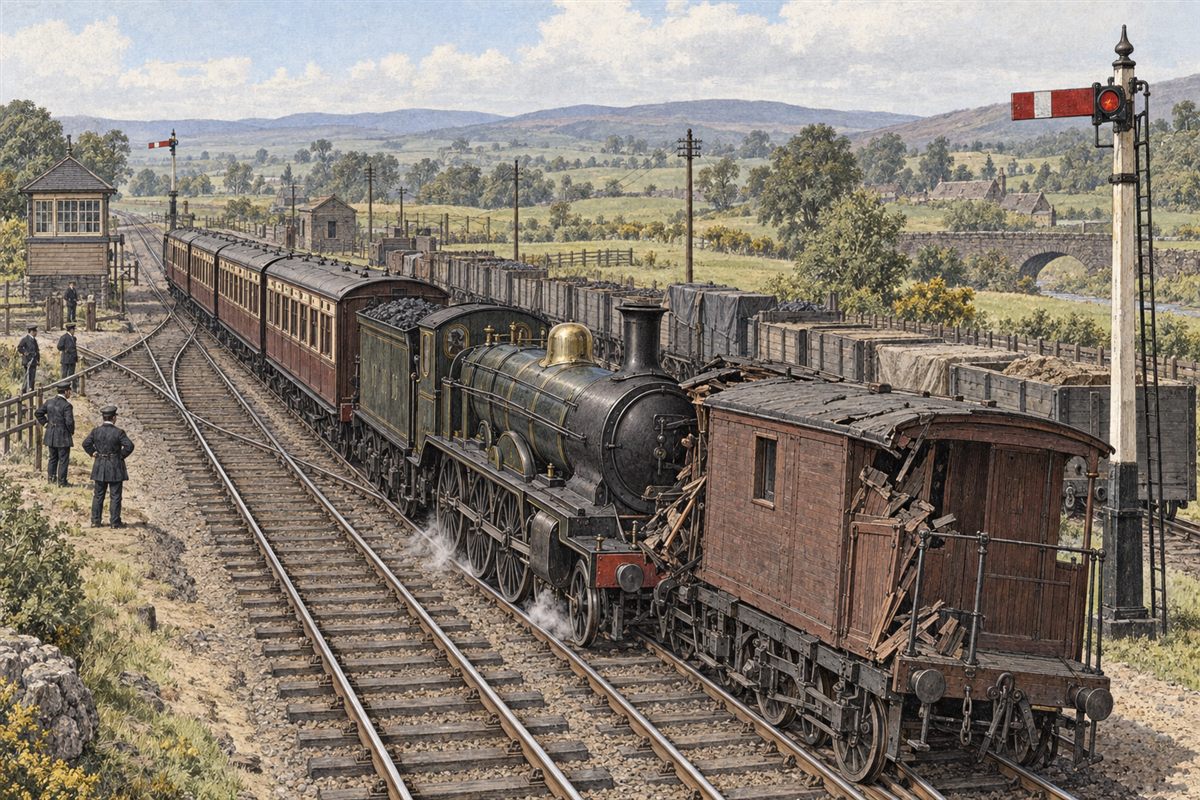
Riddings Junction · rear collision
Passenger train struck stationary goods train at Riddings Junction
A passenger train ran into the rear of a stationary goods train at Riddings Junction.
How events unfolded
- A goods train stood at the Riddings home signal.
- A following passenger train passed the distant signal at danger.
- Although the obstruction became visible, the driver did not recognise it until very close and struck the rear of the goods train.
- Seven people were injured; the inspector stated that block-telegraph working would have prevented the accident.
- Trains or operations
- Passenger train; stationary goods train
- Fatalities
- 0
- Injuries
- 7
Evidence gap: The later installation date or procedural response has not yet been demonstrated from a subsequent source.
No authenticated accident-scene photograph has been located. The illustration above is an evidence-led interpretation, not historical evidence.
Read the report record ↗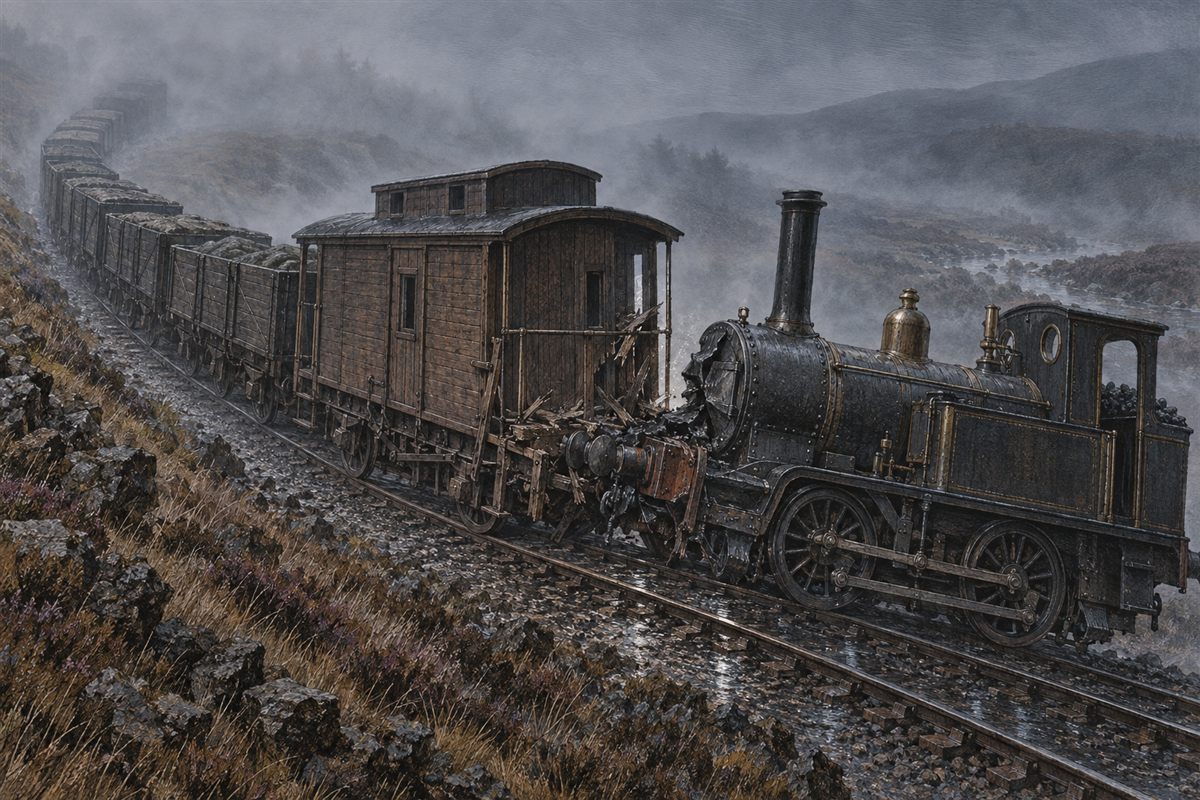
Steele Road–Riccarton Junction section · runaway / collision
Runaway wagons collided with a light engine
Runaway wagons collided with a light engine on the steeply graded section between Steele Road and Riccarton Junction.
How events unfolded
- A coupling pin fractured in the fourth wagon of the 1:00 a.m. Carlisle-Portobello goods train about 2 miles 72 chains from Steele Road.
- The rear portion—35 wagons and a brake van—ran back down the 1 in 75 gradient.
- After running back about 1 mile 27 chains, it met a Riccarton pilot engine that had left Steele Road at 3:27 a.m.
- A curve and fog restricted warning; the driver could reverse, but the fireman had insufficient time to apply his brake.
- Trains or operations
- Runaway wagons; light engine
- Fatalities
- 1
- Injuries
- 1
Evidence gap: The complete damage account, recovery and verified date of any resulting operational change remain to be extracted.
No authenticated accident-scene photograph has been located. The illustration above is an evidence-led interpretation, not historical evidence.
Read the report record ↗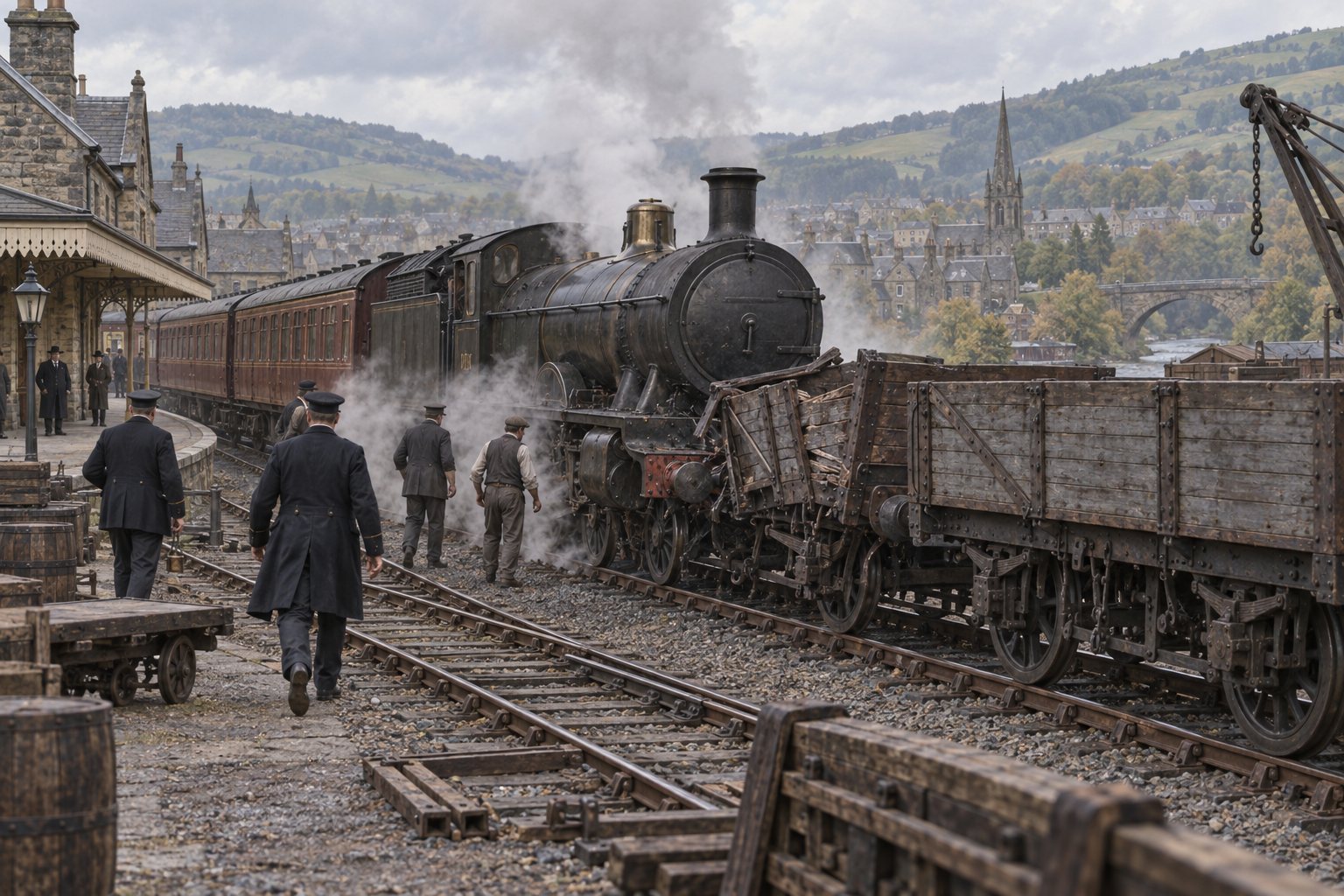
Galashiels · collision
Passenger train collided with empty trucks at Galashiels
A passenger train collided with empty trucks at Galashiels.
How events unfolded
- A passenger train entered or moved within the Galashiels station area.
- Empty trucks occupied or entered a conflicting position.
- The passenger train collided with the trucks; the detailed shunting and signalling sequence remains unknown.
- Trains or operations
- Passenger train; empty trucks
- Fatalities
- Not established
- Injuries
- Not established
Evidence gap: Train identity, time, shunting movement, signalling or point sequence, casualties and clearance require the full report.
No authenticated photograph of the 1899 collision or incident-specific film has yet been located.
Read the report record ↗